
The Tabernacle: Israel's Tent of Meeting
A movable sanctuary that accompanied Israel from Mount Sinai to the Promised Land, the tabernacle was God's appointed dwelling among His people — and a lasting picture of His desire to live with them.
What the Tabernacle Was
God said, “I want Israel to make a sanctuary for me that I might dwell among them”. It was also called the “Tent of Meeting”, where His glory invaded (Ex 25:8-9, 40:29-35). This portable tent-like structure, designed for use on the journey to the Promised Land, was dedicated to the worship of God and was the focal point of the Israelites’ lives. Detailed instructions were given for its construction and for the duties of the priests and Levites who were responsible for its use (Ex 25-40). It was over 400 years before it was replaced by Solomon’s temple, the permanent place of worship in Jerusalem.
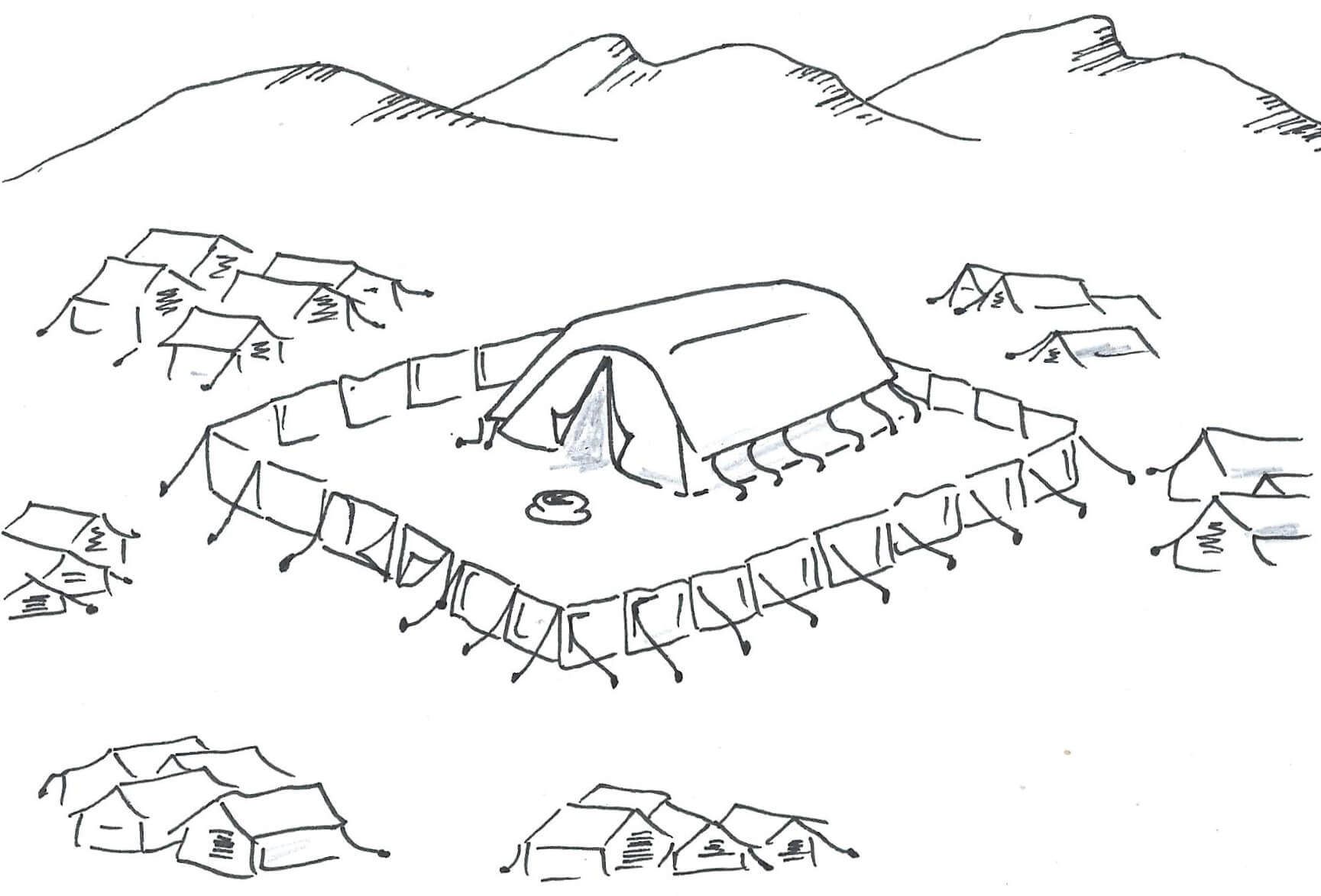
Structure and Furnishings
The tabernacle area consisted of three distinct parts.
1/. The outer court, measuring 150 by 75 feet (45 by 22.5m) and enclosed by curtains, was accessible to all the people. It contained a large altar for the numerous animal blood sacrifices, and a large basin for the priests to wash.
2/. The actual tabernacle tent, about 45 by 15 feet (13 by 4.5m), was divided into two rooms. The “holy place”, about 30 by 15 feet (9.1 by 4.5m), into which only the priests could enter, contained a seven-branched lamp stand with candles continually burning, a small altar of incense, and a table on which 12 loaves of unleavened shewbread were placed each Sabbath. A curtain separated it from the remainder of the tent.
3/. The “holy of holies”, or the most holy place. The high priest could only enter once per year to sprinkle the atoning blood on the ark – a chest which symbolically was God’s earthly dwelling place (2 Sam 6:2; 1 Kgs 8:29). During the years in the desert this whole structure was dismantled, carried, and then re-assembled by the Levites as the Lord directed by the movement of the cloud (Ex 40:36-38).
From Tent to Temple
The original tabernacle was the place where God dwelt with the Israelites, where His presence resided. After Israel crossed the Jordan it was erected at Shiloh, where it remained through the period of the Judges (Josh 18:1; 1 Sam 1:3). In a later, troubled age the ark was captured by the Philistines and the shrine at Shiloh fell into decay (Ps 78:60-61), reminding Israel that the tent's power lay not in its fabric but in the God who presided there.
King David brought the ark to Jerusalem and pitched a tent for it there (2 Sam 6:17), and it was his son Solomon who finally replaced the movable tent with a fixed temple on Mount Moriah, furnishing it with the same furnishings and placing the ark in its innermost room (1 Kgs 6:1-38, 8:6). Even then the old tent was not discarded: it was brought up and stored with the temple treasures, a witness that the new house inherited the calling of the old (1 Kgs 8:4).
Throughout the centuries that followed — exile, return and rebuilding (Ezra 3) — the pattern endured: God graciously provided a dwelling among His people, and the place of worship shaped the life of the nation. Yet each successive structure was only a copy and shadow of something greater (Heb 8:5).
The fullness came in Jesus: “The Word became flesh and made His dwelling among us” (Jn 1:14) — literally, “tabernacled” among us. In Him the tent of meeting found its true meaning, for in His body God Himself came to live with His people (Col 2:9). Now God, through the Holy Spirit, lives in all believers, who together are being built into a spiritual house (1 Cor 6:19; 1 Pet 2:5), yet there is a greater level still to come, when “The dwelling place of God is with people and He will live with them” for ever in the New Jerusalem (Rev 21:3).
God, through the Holy Spirit lives in each believer
Reflection and Application
- God's deepest desire is not to be watched from a distance, but to dwell among His people.
- Make space each day to be aware of God's presence through prayer and Scripture.
- Serve faithfully in the small, unseen tasks of your community, as the Levites did.
- The tabernacle points forward to Immanuel, “God with us”, and to God dwelling with His people for ever.
See also: ark (2), Holy Spirit, Levites, Presence of God, priests, sacrifice and offering, Temple.